All Case Studies
MEDICAL Edge AI Computer Vision Medical

Cancer Detection in Pets

ML-based early detection of cancer cells in pets using CNN and OpenCV

6mo
Duration
8
Team Size
Python / CNN / OpenCV
Core Tech
Cancer Detection in Pets
Problem

Cancer detection today requires a lab technician to manually inspect cell samples under a 400-1000x microscope. The process is time-consuming, expensive, and dependent on expert availability — delaying diagnosis and treatment.

Objective

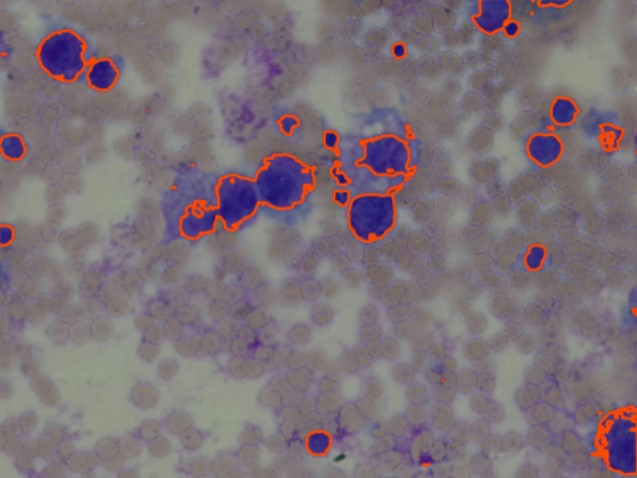
Develop an AI-based diagnostic system using CNN to automatically analyze microscopy images, segment individual cells using OpenCV, and classify whether a sample contains cancerous cells — enabling faster, accessible diagnosis for veterinarians worldwide.

System Architecture

AI Models

  • CNN (Convolutional Neural Network)
  • Mast Cell Classifier
  • Custom Training Pipeline

Software

  • Python
  • OpenCV
  • Cell Segmentation Module
  • Dataset Preprocessing Pipeline
Technical Stack
Python CNN (Convolutional Neural Network) OpenCV TensorFlow / Keras Cell Segmentation
Deliverables
WP1
System Requirements & Dataset Definition
Define cancer types in scope, collect and label microscopy image dataset, establish accuracy and performance thresholds.
WP2
Cell Segmentation Pipeline
Develop OpenCV-based preprocessing to isolate individual cells from full microscopy images, creating a clean per-cell dataset.
Results

System successfully detects mast cell cancer in pet samples with high accuracy. Deployed in partnership with PetCellScan and used by veterinarians worldwide. Roadmap includes expansion to additional cancer types.

> 92%
Cancer Detection Accuracy
> 95%
Cell Segmentation Precision
1 (Mast Cell)
MetricValueCancer Detection Accuracy> 92ll Segmentation Precision> 95ncer Types Supported

About The Cancer Recognizer project (Computer Vision)

Today cancer is one of the most widespread diseases on the Earth. Fortunately, it is possible to fight back with cancer if it is detected in time. Usually, it is done by taking a testing sample and sending it to the laboratory, where the example is put under the microscope. After enlarging by 400 or 1000 times, this sample is going to be inspected by the experienced doctor, who concludes whether this example includes cancer cells or not. Our development team has come up with an idea to mimic the detection process and to train AI-based system to recognize potentially dangerous cells. In order to achieve our goal, we are going to create a special system, based on CNN (convolution neural network), whose purpose is to analyze images from the dataset and make conclusions.

Before providing images to the system, we are going to “cut” every cell from the initial image (no matter if it has cancer or not) and thus create a new dataset that includes only cells. This procedure is using a few instruments from the OpenCV library. This technique is going to ease our system’s training process significantly.

The conclusion of the system is a prediction provided to the user about the current sample if it includes cancer cells and their amount is enough for diagnosing the cancer or not.

So far, the system is ready to diagnose only one type of cancer: mast cell. In the future, we are expecting to expand the system’s possibilities on other types of cancer.

Delivered Under